Here is another guest post by Paul. "The Thief" reader Justin left a comment on Paul's first post: "Big thanks to you Paul for sharing your experience! Always been a huge admirer of the film and Errol's other work... So could you say more about the "bath" and the specific process/ materials you'd use to make one of the BG's?"
Here is Paul's reply: "A lot of Errol's backgrounds were in the film. I think he did the Lion Fountain sequence, a lot of the market stalls, the atmospheric distant hills, the city behind Yum Yum's beautifully rendered roses, and a lot of the War Machine. I never met him, so I don't know too much about his techniques, but I was told he often put his backgrounds in a bath. I tried this with the Zig Zag tower background which had a sort of milky sky. Dick wanted more stars in the sky and the city outside the window more "magical," and he gave me some Edmund Dulac photocopies from "The Arabian Nights" and "The Rubaiyat of Omar Khyyam," as well as some photocopies of Persian miniatures. There was always a lot of reference to look at.
Anyway, I must have dipped the background in the bath half a dozen times,taking it out of the water, adding more blues and greys, and trying to feather out the "tide lines" with a soft brush. Gradually the sky became fuller and milkier, so I put the stars on and John made them twinkle under the camera.
We usually used gouache for the skies as the chalk in the gouache got rid of a lot of the streakiness that sometimes happens if you do a wash with watercolours. However, watercolour washes were used for lots of the really dark backgrounds and gently airbrushed on top to hide any streaks. Generally we tried not to use airbrushing. Some watercolours really stain the paper and you can get a really intense dark effect, e.g. for the Camp of the One Eyes and in the War Machine. Some people were naturally more suited to certain scenes and we each tended to get whole sequences of those scenes. Some of the skies were absolutely flat, some a vignette of two colours and some milky and cloudy. Sometimes spiralling Persian miniature clouds floated by. That looked great on a flat sky. When the grey Polo Scene sky met the peacock blue "beauteous evening" sky Dick stuck a rainbow effect in to hide the join. It worked perfectly.
Anyway, the idea of dipping the backgrounds into a bath was that some of the colours floated off and some remained on the paper (we used watercolour paper, not illustration board.) It made everything look richer, like an underpainting for an oil painting. For rocky scenes, (e.g. in Tack's cell,) you can get a good craggy effect by dabbing randomly with a paper towel after wetting the bg. Then put more colours on and keep doing it 'til it looks rocky. There was often a slight grainy effect of the waterclour on the paper which you often see in the Dulac illustrations. If we had used acrylic animation paints it wouldn't have had the same lightness with the paper being part of everything and adding atmosphere. I guess all this is kind of stating the obvious, but if this is in some way useful then so be it!
Anyway, it was areal privilege to have had the opportunity to work on The Thief. Absolutely."

Sunday, May 25, 2008

Sunday, May 18, 2008
Roy Naisbit - part deux
"What did the frog say to the Warmachine?"
"Rivet, Rivet"
And that is what this giant monstrum of a siege machine boils down to. Rivets. Many rivets. Hundreds, thousands, maybe millions. Before I joined the team I didn't even know the word "rivet". Afterwards I wished I never had.
Not really, just joking :) But if you have taken a close look at Roy's designs, you see how much he and Dick loved rivets. They are everywhere. And without more funny or interesting stories to tell, let's have more eye-candy from the master himself.

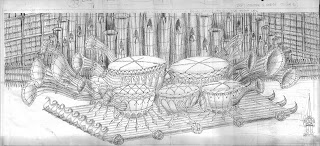


"Rivet, Rivet"
And that is what this giant monstrum of a siege machine boils down to. Rivets. Many rivets. Hundreds, thousands, maybe millions. Before I joined the team I didn't even know the word "rivet". Afterwards I wished I never had.
Not really, just joking :) But if you have taken a close look at Roy's designs, you see how much he and Dick loved rivets. They are everywhere. And without more funny or interesting stories to tell, let's have more eye-candy from the master himself.


Saturday, May 17, 2008
Warmachine through King Nod's telescope
We received this very nice assembly of King Nod's P.O.V of the warmachine from Luke Menichelli and think it is definitely worth sharing.


Friday, May 9, 2008

Thursday, May 8, 2008
Roy Naisbitt – certified genius.
Holger, Andreas, Michael and I felt like kids in a candy store working on the Thief. There was talent and inspiration oozing from every corner, and seeing even the tiniest scrap of paper land in a waste bin could break our hearts.
Naturally it wasn’t long before an unspoken pact was made to liberate anything that landed in the bins. If for nothing else, then to save it for the after world.
The drawback is that one ends up wading through heaps of paper and cells, but slowly a single pile is emerging and building up, containing Layouts and Designs that Roy Naisbitt made of and for the war machine. Some are copies, some are originals, all are huge.
As the workload piled up, we spend more Saturdays and Sundays at the studio and every one of my Saturdays would begin by visiting
So with
What would be better? Well, a few pints of Lager at the local pub of course!


Tuesday, May 6, 2008

Thursday, May 1, 2008
Chase Part 1
This sequence was all new material which had not been touched by Ken or Art. It's also full of optical illusions.
same scene: Neil
all: Neil

left: Neil
middle and right, same scene: Dick

left and middle, same scene: Dick
right: Dick

 Dick animated all these runs very quickly. First he posed out the contact positions for one leg, plotting out the progression in space. Inbetween those he would draw the contact positions for the other leg, then do the breakdowns for the passing positions, just as he describes it in his book.
left: Dick
middle: Dick
right: Dean
 The first scene has a nice trick by Roy, where he utilized the strobing effect of the circles to animate the pattern within. Later in the film Dick asked me to use the same trick to animate the hands of the Witch Mountain when the Thief is flying by.
For the second scene Dick semi-rotoscoped a scene from a Marx Brothers movie, Duck Soup, I think. I'll try to get a screengrab, hopefully tomorrow.
Dick

same scene: Dean
 One of the highlights of the film with a stunning animated camera move. This appears as a long continuous scene without visible cuts, but because of the fast action and foreground elements working as a wipe there were opportunities to divide this into separate scenes. I don't know if that was the case, but it would have made the scene easier to manage.
Dick had used the idea before in Ragged Ann and Andy: ...which was in turn directly inspired by Little Nemo:
same scene: Neil

all: Neil

left: Neil
middle and right, same scene: Dick

left and middle, same scene: Dick
right: Dick

 Dick animated all these runs very quickly. First he posed out the contact positions for one leg, plotting out the progression in space. Inbetween those he would draw the contact positions for the other leg, then do the breakdowns for the passing positions, just as he describes it in his book.
left: Dick
middle: Dick
right: Dean
 The first scene has a nice trick by Roy, where he utilized the strobing effect of the circles to animate the pattern within. Later in the film Dick asked me to use the same trick to animate the hands of the Witch Mountain when the Thief is flying by.
For the second scene Dick semi-rotoscoped a scene from a Marx Brothers movie, Duck Soup, I think. I'll try to get a screengrab, hopefully tomorrow.
Dick

same scene: Dean
 One of the highlights of the film with a stunning animated camera move. This appears as a long continuous scene without visible cuts, but because of the fast action and foreground elements working as a wipe there were opportunities to divide this into separate scenes. I don't know if that was the case, but it would have made the scene easier to manage.
Dick had used the idea before in Ragged Ann and Andy:
 ...which was in turn directly inspired by Little Nemo:
Wednesday, April 23, 2008
Jane Wright, Part 1
I have been emailing with Jane Wright. I updated a few of the recent posts with some of the information she gave me. 4/2, 4/4, 4/14
I also pasted parts of her emails into this guest post:
I also pasted parts of her emails into this guest post:
Many amusing stories have been told of Dick's outbursts and I do smile when I hear them, but really, I only ever witnessed the more gracious side to his personality as a director. Working downstairs no doubt helped. After my very first scene (Thief splashing into moat) had been shown in rushes I passed Dick on the stairs later that morning. He was deep in conversation with two or three other VIPs - probably Roy, John L. and Peter (Bond), but as I'd only been at the studio a few weeks I wasn't sure who they all were, only who I was -- nobody. So I shuffled past them all with my head down. I was halfway down the stairs when Dick broke off from his conversation, turned round and said, "Great splash!" before continuing his discourse.
While it's probably true that he knew such comments could make you cancel your plans for the evening, sharpen your pencil and work until midnight instead, it's moments like that which stay with you forever. A lesser director might build you up with a trace of condescension, yet Dick had a way of drawing out the best in many people and making you feel your contribution was much greater than it actually was. That's a rare gift. Whether it was because I was so far down the food chain doing only effects, or whether it was because I was more keen than artistic, or whether it was just beginner's luck I can't say, but it's the highest part of a human being which steps aside and allows a far dimmer light to shine to its brightest potential for a brief moment.
I think I was about 9 years old when the scene was first animated by Ken Harris. I remember well the awe of seeing a dope sheet with the names: Ken/Dick/Jane in the 'animated by' tick box and knowing that the scene had remained boxed up all the way through my school and college years. I guess we've all got memories like that from The Thief....
You might want to track down John Cousen, if you haven't already, he animated all the witch's vapour effects. Graham Bebbington and Lynette Charters were the other two effects animators from the Forum days. Heather Tailby did a scene or two also. Lynette did most of the animation - sand dunes, clouds, etc. - in the opening sequence with the prophecy. And Julie Penman was everyone's hard-working assistant and carried so much of the workload with very little credit. When you have Julie assisting you, your workload is lifted off your back on angels' wings...
The bubbles... (see 4/14/2008 post)
Neil set the style for the outlines for the first 15 feet or so, then handed the sequence over with the brief that they should move more like breasts, adding with an oblique glance, "Those are Dick's words, not mine!"
Not sure I was up to the challenge and thinking this might be more of a bloke's job, I nevertheless finished the rest of the bubble animation, then set about experimenting with the reflections, distorting all those little tiles on the floor.
The bubbles on most of those Thief scenes were animated on three levels with the idea that when shot on different passes, the bubbles behind would still be seen through the bubbles in the foreground. They ended up being painted all on the same level as it would have been too expensive to paint and shoot with three levels, so a lot of that detail and also the depth was lost. After the first scene was approved on twos and I was told to put it on ones I saw at first only the size of the job - I think it was about 80 odd feet - that first scene where the Thief squeezes out of the hole. "He wants it on ones", I moaned when I got back downstairs, "It'll take forever." "Well, you're not going anywhere, are you?" John C. quipped in response. He was right, I wasn't going anywhere - not for a long time! I was of course thrilled when it was actually finished on ones (due in large part to Julie who handled much of the assisting for the sequence and also kept track of all the different levels and who was working on what). The experience taught me not to look at the whole mountain, just the next two or three steps ahead. In proportion to the rest of the film it wasn't a mountain anyway, just a small hillock, but it's still the longest and largest scene I've ever worked on.
The day the studio closed I was in Wales. Lynette called me in the morning with the sad news and I jumped straight into my car. Four or five hours later I was in Camden joining in with the lamentations and farewells of my comrades. Dick's first words to me were "Sorry we couldn't finish your bubbles on three separate levels." I was shocked because nothing was further from my mind. It was really quite humbling because he'd just lost his whole film and I wanted to say something to him that wouldn't sound completely lame, yet he magnanimously drew the attention away from himself and was really there for all of his crew. But then that was how he was on so many occasions that I recall.
I know a man's grace doesn't sell many tabloid newspapers and wouldn't raise a chuckle over a few pints in the pub, but it's a side to Dick that is very real and perhaps gets eclipsed by the more 'colourful' facets of his personality when stories are being told. Because of his kindness, his encouragement and the example he set as a hard worker rather than a delegator, the year and a half I spent working under his direction is right up there as a 'Jim'll Fix It' episode in my life. (Actually, it was John Cousen who fixed it for me to work there, but that's another story...)
Thursday, April 17, 2008
Throw in the kitchen sink...er...kettle.
My apologies to my fellow bloggers that I have been away for so long. I shall try and contribute more in the future – but concerning the different scenes I worked on, this will be an interesting undertaking. As you will see in one of my future entries, Dick entrusted me with a scene that would keep me and 3 assistants busy for an entire year.
I was preparing to assist on the next scene, when already a re-arranging of animators and assistants happened. No sooner had I settled in at “The Forum” at Camden street, that I packed my bags and moved to the legendary “138 Royal College street”. Dick had decided that I might as well go ahead and animate my first very own scene. This was – as it turned out – part of a master plan, where we young and hungry assistants soon became junior animators and the hours that we put in voluntarily would put pressure on the other animators too.
But right now, I was in heaven. I worked in the lair of the master himself, just one floor below and on my own scene. I happily met with Dick, and he presented me with a sketch for “Kettle”:

To the "uninitiated" (me) this looked like a case of “huh?” But as the image below shows, Roy Naisbitt clearly read Dick’s intentions and as usual created a beautiful layout.

Today, in times of computer animation and programs like “Massive”, known from Lord of the Rings, even the armies of the Mighty One-Eye would be laughably small. But in 1990, we only had the mighty “Xerox” and patience on our side. The “2.5-D perspective” of the artwork really was a benefit here, as it meant we (warmachine) animators could cheat perspectives in complicated scenes like these and with all the FX going on and the fast cutting, we could get away with placing and tracing many characters.
When hand-drawing a tray with 40 one-eyes that gets destroyed by a rocket, impaling many soldiers and throwing the others to the abyss over 75 drawings time just flies by..and before you know it, 3 weeks are over….


Monday, April 14, 2008
Second Pipe Sequence and Bathroom
updated
All: pipes by Ken/Raymond
Left: pipes by Ken/Raymond, Thief by Ken/Dick
Middle: pipes by Ken/Raymond
Right: Thief by Ken/Neil, bubbles by Neil/Jane Neil did the first 15 feet or so of the bubbles just to set the style, and then it was handed over to the Effects Dept. where the bubble animation was continued, and reflections were added throughout.
The effects animators also animated the bubbles with reflections for the rest of the sequence.
Left: Yumyum by Tissa David/Neil, not finished under Dick's direction
Middle: Jewel F/X by Mick Burns
Right: Thief by Ken/Neil, bubbles by Jane (reuse of scene above) In the days following the shut down of the production by the Completion Bond Company, Dick suggested to Neil Boyle and John Leatherbarrow that if there was any way they could continue to work on the production they should. Neil and John, joined by Effects Supervisor John Cousen and Color Modelist Barbara McCormack, then set up Premier Films to help finish The Thief and the Cobbler. From a new studio space in London they were able to employ a large number of the artists that had worked under Dick, and worked only on sequences that had already been carefully planned out by Dick with his storyboards, as well as finishing scenes through to trace, paint and shooting that had already been started under Dick's direction.
The Princess scenes for this sequence fall into these categories. In the 70's Tissa David had done scenes with originally 2 Princesses who were sisters. Neil and later in 2 scenes Tim were trying to reference Tissa's original scenes where possible, but because the dialogue had changed, the actress voicing it had changed, and the whole original set up of the scene had changed (i.e. that the original scenes were dialogue between the two Princesses Mee Mee and Yum Yum, but Dick had subsequently cut out Mee Mee from the story) -- that all meant that much of the Princess stuff had to be done anew. But the intention was to try and keep any nice poses or attitudes from Tissa's original drawings where possible, and integrate them into the new Princess design and the new geography of the shots.
Left: Yumyum by Tissa David/Neil, not finished under Dick's direction
Middle: Thief by Ken/Neil, bubbles and reflections by Jane
Right: Yumyum by Tissa David/Neil, Thief by Ken/Neil, not finished under Dick's direction

Left: Yumyum by Tissa David/Tim, Thief by Ken/Tim, not finished under Dick's direction
Middle: Tissa's linetest, originally there were 2 princesses in this scene
Right: Thief by Ken/Neil, bubbles and reflections by Jane
Left: Tissa's linetest
Middle: Yumyum by Tissa David/Tim, not finished under Dick's direction
Right: Thief by Ken/Neil, bubbles by Jane (not reflections) Tim's drawings of Yumyum here are very faithful to Dick's storyboards
Left: Yumyum by Tissa David/Tim, not finished under Dick's direction
Middle: Thief by Ken/Neil, bubbles by Jane (not reflections)
Right: Tissa's linetest
 Neil also animated the curtain for the middle scene.
All: pipes by Ken/Raymond

Left: pipes by Ken/Raymond, Thief by Ken/Dick
Middle: pipes by Ken/Raymond
Right: Thief by Ken/Neil, bubbles by Neil/Jane
 Neil did the first 15 feet or so of the bubbles just to set the style, and then it was handed over to the Effects Dept. where the bubble animation was continued, and reflections were added throughout.
The effects animators also animated the bubbles with reflections for the rest of the sequence.
Left: Yumyum by Tissa David/Neil, not finished under Dick's direction
Middle: Jewel F/X by Mick Burns
Right: Thief by Ken/Neil, bubbles by Jane (reuse of scene above)
 In the days following the shut down of the production by the Completion Bond Company, Dick suggested to Neil Boyle and John Leatherbarrow that if there was any way they could continue to work on the production they should. Neil and John, joined by Effects Supervisor John Cousen and Color Modelist Barbara McCormack, then set up Premier Films to help finish The Thief and the Cobbler. From a new studio space in London they were able to employ a large number of the artists that had worked under Dick, and worked only on sequences that had already been carefully planned out by Dick with his storyboards, as well as finishing scenes through to trace, paint and shooting that had already been started under Dick's direction.
The Princess scenes for this sequence fall into these categories. In the 70's Tissa David had done scenes with originally 2 Princesses who were sisters. Neil and later in 2 scenes Tim were trying to reference Tissa's original scenes where possible, but because the dialogue had changed, the actress voicing it had changed, and the whole original set up of the scene had changed (i.e. that the original scenes were dialogue between the two Princesses Mee Mee and Yum Yum, but Dick had subsequently cut out Mee Mee from the story) -- that all meant that much of the Princess stuff had to be done anew. But the intention was to try and keep any nice poses or attitudes from Tissa's original drawings where possible, and integrate them into the new Princess design and the new geography of the shots.
Left: Yumyum by Tissa David/Neil, not finished under Dick's direction
Middle: Thief by Ken/Neil, bubbles and reflections by Jane
Right: Yumyum by Tissa David/Neil, Thief by Ken/Neil, not finished under Dick's direction

Left: Yumyum by Tissa David/Tim, Thief by Ken/Tim, not finished under Dick's direction
Middle: Tissa's linetest, originally there were 2 princesses in this scene
Right: Thief by Ken/Neil, bubbles and reflections by Jane

Left: Tissa's linetest
Middle: Yumyum by Tissa David/Tim, not finished under Dick's direction
Right: Thief by Ken/Neil, bubbles by Jane (not reflections)
 Tim's drawings of Yumyum here are very faithful to Dick's storyboards
Left: Yumyum by Tissa David/Tim, not finished under Dick's direction
Middle: Thief by Ken/Neil, bubbles by Jane (not reflections)
Right: Tissa's linetest
 Neil also animated the curtain for the middle scene.
Subscribe to:
Posts (Atom)